Catching credit risk early enough to still act on it.
An AI agent that helps portfolio managers spot risk signals across large loan books, understand what's happening, and decide what to do next. It was shown at Moody's Summit 2026 in San Diego.
Too many loans, too little warning.
Portfolio managers track hundreds or thousands of loans at once. Risk shows up as a pattern across filings, market signals, and borrower behavior. It's easy to miss manually, and often too late to act on by the time it's obvious. The design problem: make an early signal visible, credible, and actionable, without adding another dashboard nobody checks.
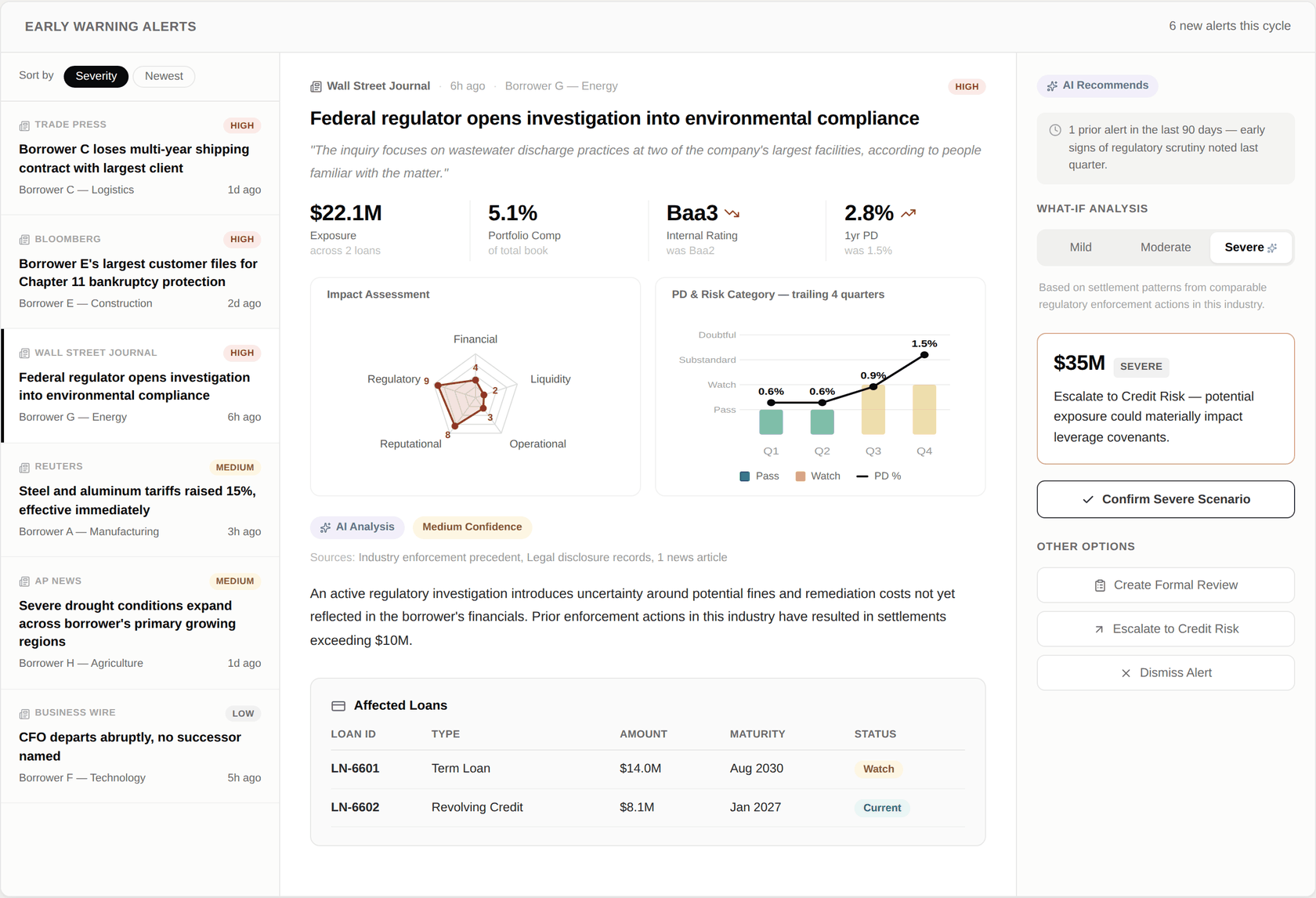
Spot, analyze, propose. Never decide.
The agent surfaces signals a human might miss, explains what's happening and why in plain language, and proposes a next step, always a suggestion and never an action taken automatically. The portfolio manager stays the decision-maker throughout.
Spot
Surface accounts with changing risk signals across the whole portfolio.
Analyze
Explain what changed and why, with a confidence level and sources.
Propose
Suggest a next step, backed by a what-if simulator for milder or worse scenarios.
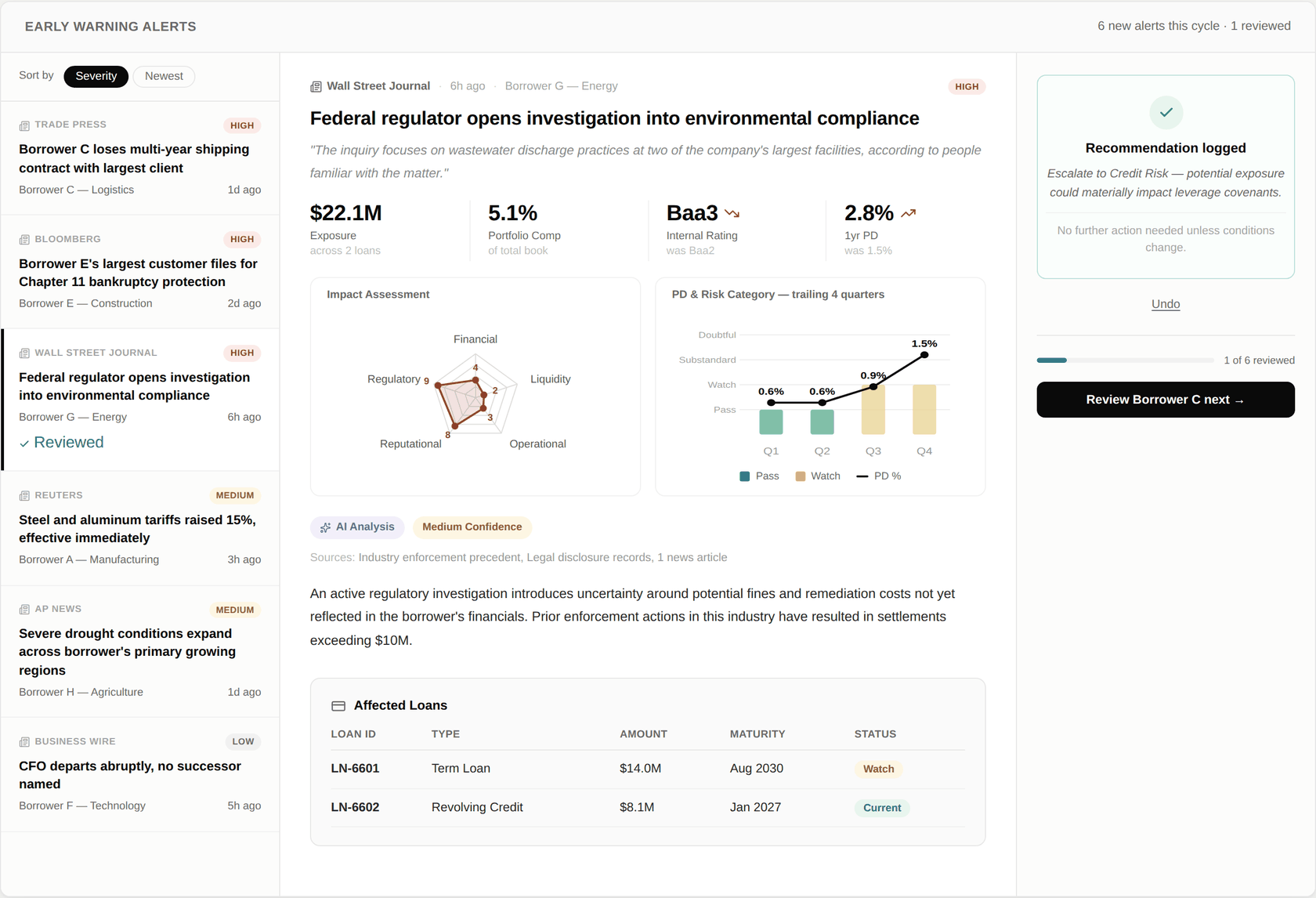
Fast enough to test with real stakeholders.
Figma Make got this from concept to a clickable prototype fast enough to put in front of portfolio managers well before a full build. The hardest question wasn't layout. It was calibrating how confidently the agent should speak, which only real risk professionals reacting to draft language could answer. That's what led to the explicit confidence badges: high for direct, quantifiable signals; lower for pattern-based inference. A PM needs to see that distinction at a glance.
- Figma Make
- Rapid stakeholder prototyping
- Iterative language calibration
Shown at Moody's Summit 2026.
The Early Warning System was showcased at Moody's Summit 2026 in San Diego, drawing notable interest from client decision-makers, a strong signal the design was solving a real, felt problem.